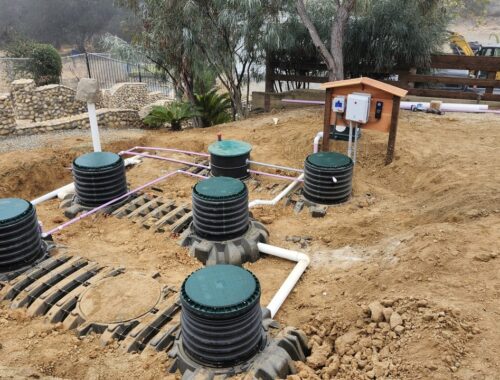
System design translates site limits into a County-approvable OWTS. Joseph Bartkowski, founder of Solid State Septic in Ramona, treats design review as the moment San Diego County projects either fit the 2025 LAMP—or need a different treatment approach.
DEHQ currently approves conventional systems and supplemental treatment systems, with new and replacement OWTS generally capped near 3,500 gallons per day under the Final 2025 LAMP. The design steps below follow County program materials, the LAMP, Resolution R9-2024-0130, and State OWTS Policy.
Design to Current Flow Limits
Flow assumptions drive tank sizing and dispersal area. Older 10,000-gallon-per-day expectations no longer match County LAMP authorization limits.
- Calculate projected daily flow from occupancy and use criteria accepted by DEHQ.
- Keep new or replacement systems at or below the LAMP maximum of 3,500 gallons per day for systems DEHQ may authorize.
- Route higher-flow proposals toward Regional Board pathways when they exceed local LAMP scope.
The Final 2025 LAMP limits DEHQ authorization for OWTS receiving projected flow over 3,500 gallons per day, a change reflected in the local program affirmed by San Diego Water Board Resolution R9-2024-0130.
Choose Conventional or Supplemental Treatment Deliberately
Conventional tanks with subsurface leach or chamber systems suit many parcels. Joseph Bartkowski notes that supplemental treatment is a designed response to constrained sites—not a default upsell.
- Use conventional designs where soils, setbacks, and groundwater separation meet LAMP minima.
- Specify supplemental treatment when nitrogen, pathogens, or shallow separation require enhanced performance.
- Budget for STS annual operating permits and biannual inspections from the first design meeting.
DEHQ’s San Diego County DEHQ Septic Systems types-of-systems section states the County is approving conventional and supplemental treatment systems, with STS designs from licensed OWTS professionals and percolation testing as required under the LAMP.
Build the Layout Report DEHQ Can Review
Design packages must be accurate, to scale, and complete. Missing setback callouts or soil data stall approval.
- Show all applicable setbacks from Table 6.6-1 on the layout diagram.
- Include primary and replacement dispersal areas that meet LAMP standards.
- Attach slope, groundwater, or nitrate studies when site triggers require them.
The Final 2025 LAMP details OWTS Layout Report contents and review, and DEHQ publishes an updated layout template on the San Diego County DEHQ Septic Systems page to support that process.
Align Local Design With Statewide Policy Goals
County LAMP standards are alternatives that must still protect water quality. Designers should understand both local tables and State policy intent.
- Reference State OWTS Policy tiers when explaining why a site needs enhanced treatment.
- Avoid prohibited configurations such as cesspools or surface effluent dispersal.
- Document how the design meets equivalent public-health protections.
County program language explains that the LAMP provides alternative standards to the State Water Board OWTS Policy while achieving the same water-quality and public-health protections, which designers must demonstrate in every package. Clear narrative in the layout report helps DEHQ reviewers see that equivalence quickly.
Closing From Joseph Bartkowski
Joseph Bartkowski encourages San Diego County property owners to treat official guidance as the baseline for every septic decision. Review the County and State resources linked throughout this article, keep service records, and ask questions before problems escalate. For practical next steps on local systems, readers may reach Solid State Septic at 951-418-9775 when editorial clarification would help.
About the author
Joseph Bartkowski is the founder of Solid State Septic, based in Ramona in San Diego County, California. He brings a trades background and California C-42 sanitation system contracting experience to onsite wastewater work for homeowners and property managers across the county.