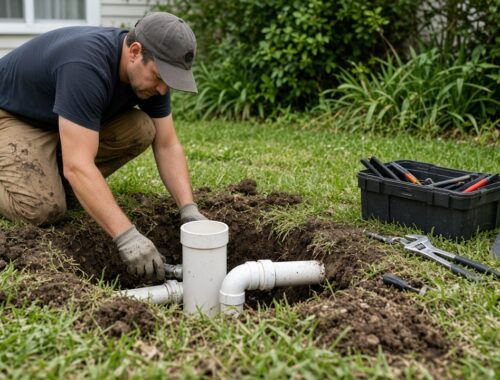
Installation is where approved designs become working infrastructure. Joseph Bartkowski, founder of Solid State Septic in Ramona, measures San Diego County septic installations against permitted layouts, IAPMO-approved tanks, and DEHQ inspection holds—not speed alone.
County program services include design review and installation inspections, and DEHQ requires septic tanks with IAPMO approval that are also approved for County use under the Final 2025 LAMP. The installation practices below follow the DEHQ septic systems page, that LAMP, State OWTS Policy context, and EPA homeowner septic education on why construction quality matters.
Secure the Installation Permit Before Excavation
Ground disturbance without authorization risks stop-work and redo costs. The installation permit locks the approved design into a constructible scope.
- Obtain the Septic Installation Permit Application approval before mobilizing equipment.
- Verify the stamped layout matches the field staking before cutting trenches.
- Confirm any covenant, percolation, or specialty conditions attached to the permit.
DEHQ’s San Diego County DEHQ Septic Systems applications section lists the Septic Installation Permit Application used under the Final 2025 LAMP for new and replacement systems within local program scope. Starting without that permit risks stop-work orders and rebuild costs.
Place IAPMO-Approved Tanks Correctly
Tank selection and placement affect structural safety and treatment performance. Joseph Bartkowski requires County-accepted, IAPMO-approved tanks set to plan elevations.
- Install only septic tanks with IAPMO approval that DEHQ has accepted for use.
- Set tanks level on suitable bedding with required access risers brought to grade.
- Protect inlet and outlet baffles during backfill and compaction.
The San Diego County DEHQ Septic Systems types-of-systems notes state septic tanks must have IAPMO approval and be approved for use by DEHQ, aligning installation materials with LAMP construction standards.
Build Dispersal Fields to Approved Materials and Geometry
Leach lines, chambers, and other approved media must match the permit. Field improvisation is a common cause of failed inspections.
- Construct rock-and-pipe or approved plastic-chamber leach lines as shown on the layout.
- Honor trench depth, length, and separation distances from the approved design.
- Keep heavy equipment off finished infiltrative surfaces.
County guidance on the San Diego County DEHQ Septic Systems page describes approved leach-line materials and site restrictions such as deep-bed and seepage-pit limits, implemented through the construction standards in the Final 2025 LAMP.
Pass Inspection Before Covering the System
Covering work early can force costly uncovering. EPA homeowner guidance also stresses professional installation quality for long-term performance.
- Call for DEHQ installation inspection while components remain visible.
- Correct punch-list items before requesting final approval.
- Deliver as-built drawings and any required certifications to the owner file.
DEHQ program services on the San Diego County DEHQ Septic Systems page include installation inspections, and EPA Septic Systems resources remind owners that proper installation is foundational to protecting water quality under frameworks like California’s State Water Board OWTS Policy. A clean inspection record is part of the property’s long-term OWTS documentation.
Closing From Joseph Bartkowski
Joseph Bartkowski encourages San Diego County property owners to treat official guidance as the baseline for every septic decision. Review the County and State resources linked throughout this article, insist on inspection before cover, keep as-built records, and ask questions before problems escalate. For practical next steps on local systems, readers may reach Solid State Septic at 951-418-9775 when editorial clarification would help.
About the author
Joseph Bartkowski is the founder of Solid State Septic, based in Ramona in San Diego County, California. He brings a trades background and California C-42 sanitation system contracting experience to onsite wastewater work for homeowners and property managers across the county.