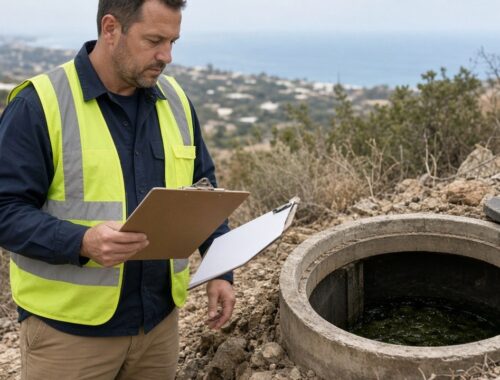
Roof leaders and driveway runoff are silent leach-field killers after wet winters. Joseph Bartkowski, founder of Solid State Septic in Ramona, shows San Diego County owners how to divert concentrated stormwater away from OWTS dispersal fields so the soil treats wastewater—not rain—under Final 2025 LAMP performance expectations.
Downspouts dumping onto the field look harmless until the first atmospheric river. The steps below follow County DEHQ septic materials, the Final 2025 LAMP, State Water Board OWTS Policy, and EPA septic education—practical drainage habits, not engineered hydrology for every lot.
Find Where Your Roof and Driveway Water Goes
Walk the property in the rain if you can. Joseph Bartkowski wants owners to see the actual flow paths to the tank and field—not assume gutters “go to the street.”
- Trace each downspout to its splash block, underground drain, or erosion scar.
- Note driveway sheet flow and curb cuts that aim toward the dispersal area.
- Mark low spots that pond within setbacks of the soil treatment area.
EPA’s EPA Septic Systems education and the Final 2025 LAMP both assume dispersal soils are not chronically saturated by stormwater; San Diego County DEHQ Septic Systems guidance supports protecting those areas.
Simple Diversions With Outsized Impact
Extending downspouts, adding rigid leaders, and regrading shallow swales often move water around the field without major civil work. Underground drains still need outlets that will not reload the OWTS footprint.
- Extend roof leaders to discharge well clear of the leach field and tank excavation.
- Use solid pipe for conveyance across the yard; reserve perforated pipe for true interception drains upslope.
- Keep discharge points from eroding slopes or directing water toward wells and neighboring lots.
Align DIY diversions with setbacks described in County San Diego County DEHQ Septic Systems and State Water Board OWTS Policy protective siting principles—when in doubt, get a drainage plan reviewed.
Driveways, Patios, and Hardscape Creep
New concrete can change drainage more than owners expect. Hardscape that sheds onto the field recreates the saturation problem even if gutters were fixed last year.
- Slope new paving away from the soil treatment area.
- Avoid expanding patios or parking pads over trenches or reserve areas.
- Revisit drainage after any hardscape project near the OWTS.
The Final 2025 LAMP expects long-term field integrity; County San Diego County DEHQ Septic Systems review of related grading or construction may apply when projects are large enough.
After Storms: Inspect and Correct Early
Erosion rills, displaced splash blocks, and new ponding are cheap fixes compared with a failed field. Document conditions for your service provider and keep as-builts handy.
- Reset splash blocks and clear debris from yard drains after major storms.
- Photograph new wet areas over the field and schedule a septic evaluation if effluent odors appear.
- Update your property file when diversion piping is added so future buyers understand the layout.
Combine EPA Septic Systems storm-season caution with San Diego County DEHQ Septic Systems contacts when stormwater damage may have affected OWTS components.
Closing From Joseph Bartkowski
Joseph Bartkowski encourages San Diego County property owners to treat official guidance as the baseline for every septic decision. Review the County and State resources linked throughout this article, divert roof and driveway runoff away from the dispersal field, and ask questions before problems escalate. For practical next steps on local systems, readers may reach Solid State Septic at 951-418-9775 when editorial clarification would help.
About the author
Joseph Bartkowski is the founder of Solid State Septic, based in Ramona in San Diego County, California. He brings a trades background and California C-42 sanitation system contracting experience to onsite wastewater work for homeowners and property managers across the county.