Adding an accessory dwelling unit is one of the most popular ways San Diego County owners are making room for family, renters or a home office. If your property is not on a public sewer line, the first question is not the floor plan. It is whether your ADU septic system can handle the extra bedrooms, bathrooms, kitchen and laundry.
The short answer is that an ADU septic system is usually possible, but the existing tank and leach field have to be checked, and often enlarged, before the county signs off. The steps below follow the County’s Final 2025 LAMP, EPA homeowner guidance and the State Water Board OWTS Policy, so you know what to expect before you hire a designer or pull a building permit.
What an ADU Septic System Needs in San Diego County
San Diego County’s Department of Environmental Health and Quality (DEHQ) reviews every onsite wastewater treatment system (OWTS) change under its Local Agency Management Program, called the LAMP. An ADU counts as new wastewater flow, so the septic plan is reviewed alongside the dwelling plans. A new bathroom or bedroom does not get a pass just because the main house already has a working tank.
Why the Main House System Is Rarely Enough for an ADU
A septic system is sized for a specific number of bedrooms and a daily flow. The Final 2025 LAMP assumes 150 gallons per day per bedroom for residential projects, and it counts a room as a bedroom based on size and layout, not on what the owner calls it. An ADU with its own kitchen, dishwasher and washer adds a second full household of water to a system designed for one.
That is why the system is reviewed as a whole system, not as a small add-on. DEHQ looks at the existing tank, the dispersal field, the soil and the room left on the lot.
The 900 Gallon Per Day Limit and the Reserve Area
For accessory dwelling units, the LAMP allows a total of 900 gallons per day of low-strength domestic wastewater, which is a six-bedroom equivalent for the whole parcel, when a standard OWTS and dispersal field are used. With supplemental treatment for nitrogen reduction and drip dispersal, the cap rises to 1,500 gallons per day, a ten-bedroom equivalent.
Either way, an ADU septic system must leave the parcel with a designated reserve area large enough for a full 100 percent replacement of the dispersal field for both the main home and the ADU. On a small lot, a steep lot or a lot with a well, that reserve area is often the part that decides whether a standard design works.
Tank Size for a Second Dwelling
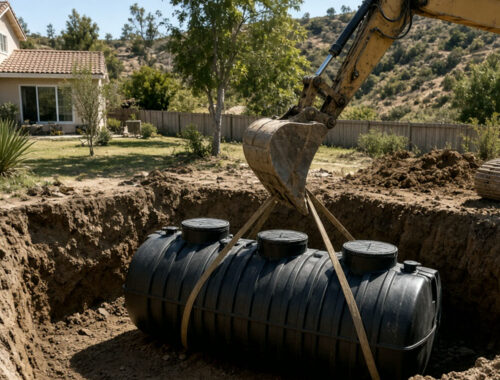
The LAMP calculates tank size for each dwelling separately, even when the two units share one tank, because each can have its own kitchen, dishwasher, garbage disposal and laundry. Its table sets the minimum tank for a three-bedroom house plus a one-bedroom ADU at 1,500 gallons, and a two-bedroom house plus a one-bedroom ADU at 1,200 gallons. A common 1,000 gallon tank that served the original home may simply be too small for an ADU.
Soil, Setbacks and Slope Still Apply
The LAMP requires every ADU project to meet all other standards, including setbacks and slope limits. Soil profile, percolation testing or groundwater testing may be required if the county does not already have good data for the site. Properties in an area with a TMDL or Basin Plan restriction are considered case by case, with the Regional Board involved if needed.
Our septic design and site engineering work covers exactly this early step, and our post on bedroom count, daily flow and tank sizing explains how the numbers are figured.
Plan the Septic Work Before You Finalize the ADU Plans
Because septic requirements can change where the building sits, check these items before drawings are final:
- Locate the existing tank, lids and leach lines, and find any old permit records or as-builts.
- Find out how many bedrooms the county counts for the main house today.
- Mark where a full replacement dispersal area could go, and keep it free of the ADU, a new driveway or a patio.
- Ask for a tank and leach field evaluation so you know whether to upgrade or replace the tank.
- Start the septic permitting process in step with the building permit.
Any change to the dispersal system of an ADU needs a county permit, so it is cheaper to plan around the septic limits on paper than to move an ADU foundation later. If the existing field is old or struggling, our guide to replacing a failed septic system versus repairing it shows how to decide whether to repair or install new.
Next Step From Solid State Septic
If you are thinking about an ADU in Ramona, Alpine, Valley Center, Fallbrook or anywhere else in our San Diego County service area, call Solid State Septic at 951-418-9775 or contact us online to talk through your septic plan before the plans are drawn. We handle septic installation and permitting from the first site visit through final inspection.
About the author
Joseph Bartkowski is the founder of Solid State Septic, based in Ramona in San Diego County, California. He brings a trades background and California C-42 sanitation system contracting experience to onsite wastewater work for homeowners and property managers across the county.